About sprinkler systems

A fire sprinkler system is an active fire protection measure, consisting of a water supply system, providing adequate pressure and flowrate to a water distribution piping system, onto which fire sprinklers are connected.
Possibly the oldest in Britain was fitted in 1812 at the Theatre Royal Drury Lane and, in an updated form, it is still in use today.
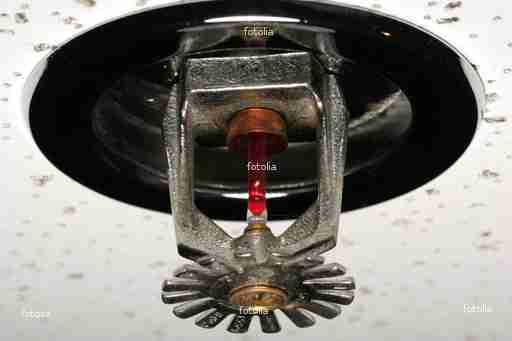
Each closed-head sprinkler is held closed by either a heat-sensitive glass bulb or a two-part metal link held together with fusible alloy. The glass bulb or link applies pressure to a pip cap which acts as a plug which prevents water from flowing until the ambient temperature around the sprinkler reaches the design activation temperature of the individual sprinkler head. In a standard wet-pipe sprinkler system, each sprinkler activates independently when the predetermined heat level is reached. Because of this, the number of sprinklers that operate is limited to only those near the fire, thereby maximizing the available water pressure over the point of fire origin.
Why have one?
A sprinkler activation will do less damage than a fire service hose stream since a great deal less water will be discharged than would typically be used by the local fire service. In addition, a sprinkler will usually activate between one and four minutes, whereas the fire service typically takes considerably longer to commence spraying water at the fire. This additional time can result in a much larger fire.
Since a sprinkler system is fully automated it will avoid the risk to life of untrained occupants of the building trying to fight the fire manually with hose reels or fire extinguishers.
Benefits
Fire protection sprinkler systems and suppression systems:
- Save lives and prevent injury
- Save buildings and significantly reduce property loss
- Typically involve less than four sprinkler heads, containing fire and minimising water damage
- Deliver water directly to the source of the fire
- Are functional 24 hours a day and operate instantly the moment a fire is detected
- Limit the production of smoke and fumes
- The protection sprinkler and suppression systems offer allows design flexibility in new buildings. In particular movement around these protected buildings are made easier due to less fire doors and lobbies
- Have long term financial benefits from insurance premium reductions
- Operation of a sprinkler system will rapidly control a fire, raise the alarm and reduce the rate of production of heat and smoke, allowing time for occupants to escape
- Drastically reduce the damage caused by a fire and therefore minimise the disruption and time taken to achieve business continuity
- Provide a dramatic reduction in harmful emissions from unsuppressed fires
- Minimise production of atmospheric pollution toxic gasses and particles
